
~Richard Feynman
How do you judge the quality of an investigation?
It’s a question seldom asked, let alone answered. As a teacher and consultant, I often read investigation reports of environmental, health and safety events, including those that have made the headlines. Some were written by the independent experts; others were developed internally. In the classes we teach on safety leadership and hazard recognition, we use case studies as one of our methods so, as the teacher, we need to understand what went wrong.
Trained as a scientist, and someone whose job it once was to track investigations and sometimes the person investigating them myself, I can’t help but evaluate and judge the quality of the reports I read. Every investigation I’ve studied did a good job collecting the facts. But there’s still a leap from facts to conclusions, which are as much a matter of opinion as they are fact.
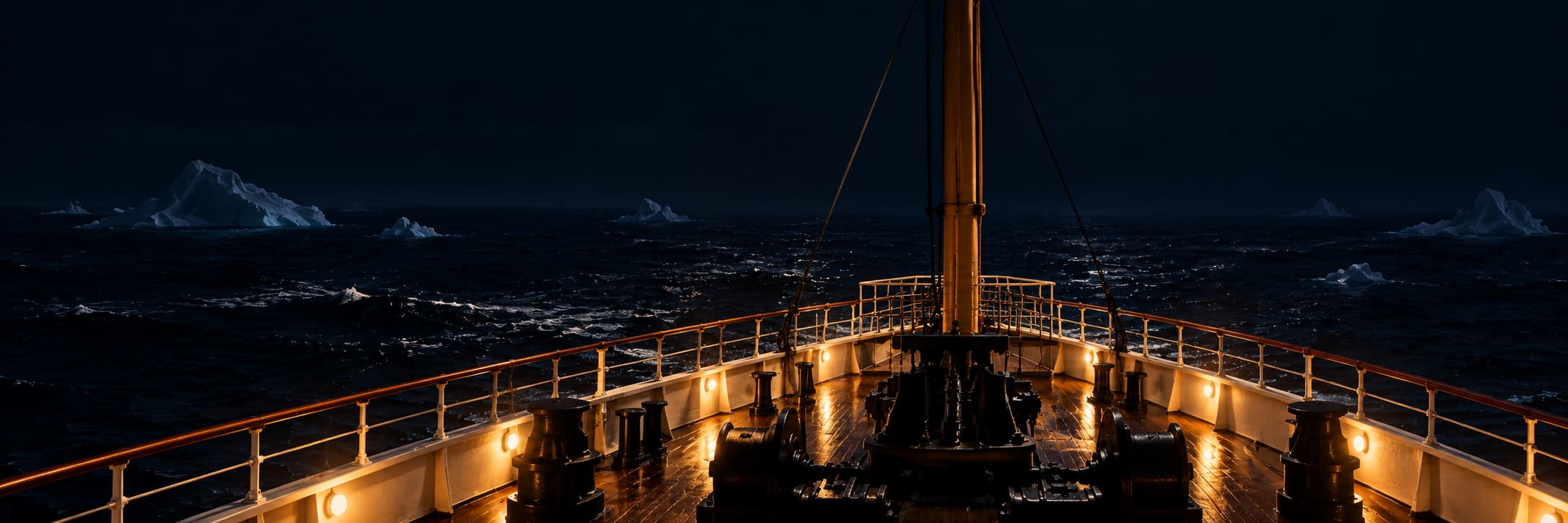
Last month, when I was on vacation touring the British Isles, I spent a morning at the Titanic Museum in Belfast. There I was, taking notes and writing emails to friends describing what I observed on my tour, starting with the Captain who went down with the ship. He didn’t think they’d encounter any icebergs, and even if they did, he was sure there would be time to avoid them.
A classic failure to recognize and manage hazards.
That led me to probe the Titanic’s procedures, management systems, and ship design: problems were everywhere. As one of many examples, lookouts were supposed to have binoculars, but they were locked in a chest on the Crow’s Nest. The officer responsible was reassigned just before the ship left port, and he took the key with him.
On the other hand, accounts say binoculars wouldn’t have helped much on that dark and moonless night.
The British Wreck Commissioners did their investigation, as did the US Senate, as many of the victims were Americans. Both came to the same conclusion: the most significant cause was the Captain’s orders to travel at high speed, through a known iceberg field, and in the dark.
A century later, seems a reasonable conclusion.
My Training
When I worked in fuel quality for a global refining, supply and distribution and retail oil company, I was the person who was responsible for tracking and investigating incidents, which usually involved either environmental events like a spill or product quality issues. We took both very seriously. Picture fifteen cars, dead at a gas station because of a bad batch of fuel: the reputational damage to the company would be huge.
Most of the time, the businesses were the ones who did the investigations. As you might expect, the refining business used safety or environmental investigation processes already set up and produced excellent investigation reports. The distribution business also used existing people and processes for safety or environmental incidents. They were good, but not at the level of expertise the refineries had. These two groups were responsible for investigating most of the serious events. Occasionally the retail business would be the one with the problem; since they had little experience, so often I would run the investigation for them.
As a graduate student, I’d written a thesis based on the scientific investigation of the enzymes involved in making the amino acid tryptophan in bacteria, but investigating an operations failure was nothing like that. In the technical organization I was a member of, we had a formal process to determine competency. There were three steps: the first was learning a job, the second was doing a job while being overseen by a senior competent person. If you passed the first two steps, you were “deemed competent” to do the job on your own.
My investigation process training involved six weeks at a major refinery as part of an incident investigation team working on a H2S release from their sulfur plant. Fortunately, there were not any identifiable health effects to deal with, but the reputational and regulatory concerns were huge, as they were regulated by local and state agencies, neither of whom were fans of our industry.
Interestingly, in qualifying people at the FAA, they have another step: to be deemed competent you have to be able to teach it. From personal experience as a teacher, I can tell you that step is not easy.
Looking back on my experience, having a process to follow and being trained made a big difference in the quality of the investigations. Most of our focus was on finding the cause; my role was to ask about the why, as the what was usually already determined.
It was rare to find an incident that didn’t have a component involving human performance, especially in the distribution or retail business. Typically, the business would make a disciplinary decision before the root cause investigation even started. I can remember talking with people who’d been demoted or sent home for a few days without pay. Those conversations were delicate, but with those consequences already received, I found they opened up better.
Thinking Slower – And Better
In the years since, I’ve read and analyzed investigation reports and taught front line leaders how the investigation process works. Recently I discovered Daniel Kahneman when I read his obituary in the Economist, after he passed away in the spring of 2024.
I read his best-selling book, Thinking Fast and Slow cover to cover. Had it been written two decades earlier my approach to investigations would have changed, starting with the why. As Kahneman saw it, most of the time we’re making decisions quickly, without giving much thought. While that works because we’re usually right, we can get tripped up by our cognitive biases. There can be times when we engage in slow, reflective thinking: that requires time and effort, but we’ll likely make a better choice.
Kahneman won a Nobel Prize in Economics by pointing out our fast decisions aren’t always in our best financial interest, so we’d be better off being forced to think slow. Automatic enrollment in a retirement savings program is the perfect example: if you don’t want to save, you have to stop, think about it, and then decide to make a different choice.
Everyone has their own cognitive biases and preferences, including investigators. Reading Kahneman reinforced my view of the value of an investigation team with people who think differently and will challenge each other. When I was involved, neither of them – fast or slow thinking – were something that ever entered my mind as an investigator. On the other hand, in the years since, I’ve yet to read an investigation where either showed up as a consideration in cause or prevention.
As I see it, Kahneman would have been fascinated by decisions that went wrong and caused an event. Because he’d be able to see fast thinking as a potential cause, he’d probably take a gentler approach to human error; someone’s tired, dealing with other things, caught by their biases, all examples of thinking fast.
As important as it is to understand cause – the why – it’s even more important to take the right steps to improve and reduce the probability of a reoccurrence. Applying slow thinking to that, Kahneman might ask, “How can we learn from this and prevent something like this from happening again?”
Part of his strategy would probably be to help people in high-risk situations use their slow thinking. Doing that doesn’t need to be left up to an investigation team to figure out after something has happened. Leaders can help their followers recognize when they might feel trapped in a fast process and need to slow down. Troubleshooting a problem would be the perfect example.
Kahneman once posed a question to a project team specifically on the subject of safety: “If a year from now there were a huge failure, what do you think that might be?” When we teach leadership practices, that’s something we call asking a Darn Good Question. It’s a way to shift from fast to slow thinking.
Kahneman won a Nobel Prize for suggesting the form for the retirement savings deduction come with the box checked “Yes.” I suspect he might think doing the same thing on the safe work permit by checking all the boxes for wearing PPE “Yes” would be a good idea, too.
The Human Cost of Failure
Today it’s a museum and stop on a cruise, but a century ago the Titanic was a tragedy. Fifteen-hundred lives were lost, passengers and crew. The museum guide included a picture of eight: they were the Goodwin family, moving to America to start a new life. Their youngest, a nineteen-month-old baby, was among the hundreds recovered, buried at Halifax, but never identified. A century later, DNA evidence finally provided closure.
Another reminder of why recognizing and managing hazards matters so much.
Peter Robison
October 2026